

AI Change Management: A Practical Guide to Leading AI Transformation and Adoption
AI implementations can look successful on a project plan and still fail where it matters: in the day-to-day work of employees. A company can select the right technology, configure it correctly, establish governance, and launch on schedule, yet see limited business value because people don’t trust the AI, don’t understand where it fits into their work, or simply continue working the way they always have.
That’s the problem change management for AI is meant to solve.
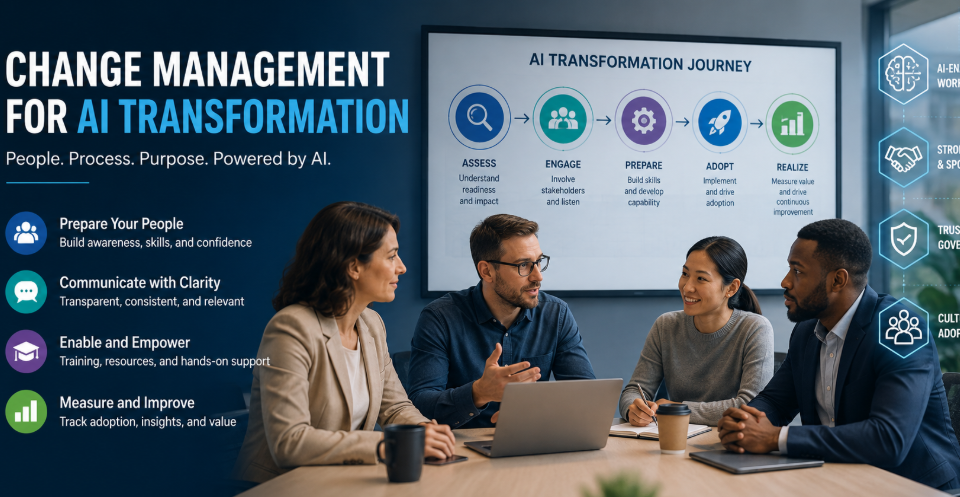
This guide focuses specifically on change management for AI, meaning the people side of implementing artificial intelligence. It covers how to assess readiness and impacts, prepare employees, address resistance, build AI capabilities, change workflows, drive adoption, and sustain new ways of working. The guidance applies to enterprise AI transformation broadly, including generative AI tools, copilots, embedded AI capabilities, automation, and increasingly, AI agents.
One distinction matters from the start. AI change management is not the same as using AI to perform change management activities. The focus here is on helping an organization successfully adopt AI and turn implementation into meaningful changes in behavior, work, and business outcomes.

Why AI Requires a Different Change Management Approach
Traditional change management practices still matter during an AI transformation. Sponsorship matters. Stakeholder engagement matters. Communication, training, resistance management, and reinforcement all matter. But applying a standard change plan without adapting it to AI can leave significant gaps.
AI changes work differently from many technology implementations because the impact isn’t always known at the beginning. A conventional system implementation may replace one application with another while leaving the underlying job largely intact. AI can change the tasks people perform, how decisions are made, what skills are valuable, where human judgment is required, and which activities are automated altogether.
There is also a trust issue. Employees aren’t simply being asked to learn where a button moved. They may be asked to rely on AI-generated recommendations, review machine-generated work, share tasks with an AI assistant, or supervise automated processes. Some employees will be enthusiastic. Others will question accuracy, accountability, privacy, job security, or whether using AI is even permitted.
An effective AI change management strategy has to address those concerns directly. Treating them as communication problems alone is usually a mistake. Some concerns require clearer governance, workflow decisions, role clarity, training, or leadership action.
Start With the Business Change, Not the AI Tool
One of the most useful questions a change team can ask is surprisingly simple: What will people actually do differently because of this AI?
The answer should go beyond statements such as “employees will use Copilot” or “the organization will adopt generative AI.” Those describe technology usage, not organizational change.
Instead, identify the business outcomes and workflow changes the AI implementation is expected to produce. Perhaps employees will use AI to prepare a first draft and spend more time reviewing and refining it. A service team may receive AI-generated recommendations but retain responsibility for the final decision. Managers may use automated analysis that changes how they prepare forecasts or allocate resources.
These distinctions matter because adoption shouldn’t be defined as logging into an AI application. An employee can use a tool regularly without changing the behavior that creates the intended business value.
Define the AI Adoption Outcome
Before developing the AI change management plan, document what successful adoption looks like. At minimum, clarify:
- Which employee groups will use or be affected by the AI.
- Which workflows, tasks, decisions, or responsibilities will change.
- What people will stop, start, or continue doing.
- Where human review, judgment, or approval remains necessary.
- What measurable business outcome the changed behavior is expected to support.
This becomes the foundation for impact assessment, communication, training, adoption measurement, and reinforcement later.
Assess Organizational Readiness for AI
AI readiness is often discussed as a technical question: Is the data available? Is the infrastructure ready? Has security approved the technology? Those questions matter, but they don’t tell you whether the workforce is ready.
An AI change readiness assessment should examine the organizational conditions that could accelerate or slow adoption. That includes leadership alignment, employee understanding, trust, existing AI skills, change capacity, manager preparedness, and previous experiences with automation or AI.
Readiness also varies across the organization. A technical team that has experimented with generative AI for two years may require very different support from an operational group encountering AI in its workflow for the first time. Treating the enterprise as equally ready can lead to unnecessary training for some groups and inadequate support for others.

Questions to Include in an AI Readiness Assessment
- Do leaders agree on why AI is being introduced and what outcomes are expected?
- Do employees understand the organization’s AI strategy?
- How much practical experience do affected employees already have with AI?
- What concerns exist about accuracy, privacy, accountability, workload, or job impact?
- Are managers prepared to answer questions and reinforce expected behaviors?
- Are AI policies and acceptable-use expectations clear enough for employees to act confidently?
Use the findings to change the plan. A readiness assessment that produces a score but doesn’t alter the change strategy has limited practical value.
Conduct an AI Change Impact Assessment
The change impact assessment is one of the most important pieces of change management for AI because it translates the technology into consequences for real jobs and workflows.
Avoid assessing impact only at the department level. “Finance is highly impacted” doesn’t tell the change team what Finance employees need. Impact becomes actionable when it identifies changes to specific processes, activities, responsibilities, skills, decisions, controls, and interactions.
For each affected group, compare the current state with the expected future state. Determine whether AI will assist a task, automate part of it, generate recommendations, create content, initiate actions, or fundamentally alter the workflow.
Pay particular attention to accountability. If AI generates an answer but an employee remains accountable for its accuracy, that employee needs more than tool training. They need to understand what to verify, when to challenge the output, and when AI shouldn’t be used.
Impact assessment should also be revisited as use cases mature. AI implementations frequently reveal new workflow implications during pilots and early adoption. The initial assessment is a baseline, not a permanent record.
Build the AI Change Management Strategy Around Impact
Once readiness and impacts are understood, the AI change management strategy can become specific. Different groups should receive different levels and types of support based on what is changing for them.
The strategy should connect sponsorship, stakeholder engagement, communications, manager enablement, training, resistance management, adoption measurement, and reinforcement. But don’t turn the strategy into a collection of disconnected OCM deliverables. Each activity should address a known adoption need or risk.
For example, if employees understand the AI but don’t trust its recommendations, another awareness campaign probably won’t solve the problem. The response may require clearer validation procedures, demonstrations using relevant work, better explanation of limitations, or changes to the workflow itself.
Make Managers Part of the Strategy
Managers deserve special attention during AI transformation. Employees will often bring questions about job impacts, expectations, acceptable use, performance, and accountability to their direct manager before they raise them with a transformation office.
Managers therefore need information before broad employee communications whenever practical. Give them clear talking points, escalation paths, demonstrations, policy guidance, and enough understanding of the change to discuss what it means for their teams.

Communicate AI Transformation Without Creating More Anxiety
Weak AI communications tend to fall into one of two extremes. They oversell AI as transformational technology that will make everyone’s work easier, or they stay so cautious and vague that employees fill the information gaps themselves.
Neither approach builds trust.
AI communications should explain why the organization is making the change, what is known, what isn’t yet known, what employees can expect, how the technology should be used, and where people can raise concerns. If roles or responsibilities may change, don’t hide that behind generic language about innovation.
Communication should also become more specific as implementation progresses. Enterprise messages can establish direction, but employees eventually need role-relevant information. A customer service representative wants to know how AI changes customer interactions. A manager wants to know what they’re accountable for. A risk professional may care more about review requirements and controls.
Honesty about limitations matters. Employees who are told that AI is highly capable and then immediately encounter inaccurate outputs may become more skeptical than employees who were taught from the beginning where human judgment is required.
Treat Resistance to AI as Information
Resistance to AI shouldn’t automatically be classified as a mindset problem. Sometimes resistance points to a legitimate weakness in the implementation.
Employees may resist because the AI produces unreliable results for their work, adds review steps, conflicts with existing performance measures, or creates uncertainty about accountability. Others may worry about job displacement or whether their expertise is becoming less valuable.
The change team should identify the source before selecting the intervention. Training won’t fix a poorly designed workflow. Communications won’t fix contradictory policies. Executive sponsorship won’t make employees trust inaccurate outputs.
At the same time, some resistance will come from unfamiliarity or preference for established methods. That can often be reduced through practical experience, manager coaching, peer examples, accessible support, and opportunities to test the technology in relevant work.
This is also where an AI champions network can be useful. Champions can provide local support and surface adoption barriers quickly, but they shouldn’t become unpaid help-desk staff or substitutes for accountable leaders. Give champions a defined role, useful information, access to the change team, and a clear way to escalate recurring issues.
Build AI Literacy, Skills, and Role-Specific Capability
AI training is often too generic. Employees attend a demonstration, learn basic prompting, receive a policy document, and are then expected to translate all of that into their jobs.
A stronger approach separates AI literacy from role capability.
AI literacy gives employees enough understanding to use AI responsibly. Depending on the technology, that may include how AI generates outputs, common limitations, data-handling expectations, acceptable use, verification, bias, and human accountability.
Role-specific capability answers a different question: How do I use this in my actual work?
Training should therefore use realistic tasks and workflows wherever possible. Employees need opportunities to practice, make mistakes in a safe environment, compare approaches, and understand what good AI-assisted work looks like.
As AI capabilities advance, reskilling may become more significant than application training. If AI assumes part of an employee’s existing workload, the organization needs to define what higher-value work replaces it and whether employees currently have the skills to perform that work. Without that clarity, productivity gains can remain theoretical.
Redesign Workflows for Human-AI Collaboration
Organizations can limit the value of AI by placing it on top of an unchanged process. Employees receive a powerful capability but are still expected to follow workflows designed for a world without it.
AI workflow transformation requires deliberate decisions about the division of work between people and technology. Determine which activities AI can perform, which require human judgment, where reviews are necessary, who handles exceptions, and who remains accountable for the final result.
This becomes even more important with agentic AI. Change management for AI agents may involve employees supervising work performed by AI, approving actions, managing exceptions, or coordinating with multiple automated systems. That is a different behavioral change from simply learning to use a chatbot.
The change management team should therefore work closely with process owners, business leaders, technology teams, risk functions, and learning teams. OCM can’t independently decide how work should be redesigned, but it can make sure those decisions are translated into understandable role impacts and adoption actions.
Connect AI Governance to Employee Adoption
AI governance is often handled as a policy, technology, legal, or risk workstream. From a change management perspective, governance also affects behavior.
Employees need practical answers. What data can they enter? Which AI tools are approved? What outputs require verification? When must AI-generated work be disclosed? Who is accountable for a decision supported by AI? What should an employee do when the AI produces something questionable?
If those answers are unclear, employees may avoid approved AI because they fear making a mistake. Others may use unapproved tools because they’re easier or because official guidance doesn’t fit the work. Both outcomes undermine enterprise AI adoption.
Translate governance into role-specific guidance employees can apply during normal work. Policies are necessary, but policy documents alone rarely produce consistent behavior.
Measure AI Adoption Beyond Logins and Usage
Usage data is useful, but it can create a false sense of progress. A high number of licenses activated, prompts submitted, or monthly users tells you that employees are interacting with the technology. It doesn’t necessarily tell you whether work has changed or value is being created.
AI adoption metrics should connect several levels of evidence. Depending on the implementation, useful measures can include:
- Access and activation among intended users.
- Frequency and consistency of appropriate AI use.
- Adoption of the targeted AI-enabled workflow or behavior.
- Employee confidence and capability.
- Recurring barriers, support requests, errors, or workarounds.
- Operational or business outcomes tied to the use case.
The exact measures should reflect the use case. A generative AI writing assistant, predictive decision tool, and autonomous AI agent shouldn’t share an identical adoption scorecard.
Look for the Gap Between Usage and Value
One of the most useful diagnostic questions is whether employees are using AI in the way the business case assumed they would.
If usage is high but expected outcomes aren’t appearing, investigate the workflow and behavior before assuming the technology has failed. Employees may be using AI for low-value tasks, duplicating work, over-reviewing outputs, or ignoring capabilities that matter most to the business case.
Reinforce Adoption as AI Continues to Change
AI change management rarely ends neatly at go-live. Models improve, capabilities expand, policies change, new use cases emerge, and employees find ways of working that weren’t anticipated during implementation.
Plan for reinforcement after launch. Monitor adoption data and employee feedback. Identify where teams are struggling and where unexpected good practices are emerging. Update training and guidance when the technology changes. Give managers information they can use to reinforce expectations during normal team conversations.
This is also the point where an organization can distinguish between adoption problems and product problems. If a use case consistently creates more work than it removes, change management shouldn’t be used to pressure employees into accepting it. The workflow, technology, or business case may need to change.
Sustained AI adoption depends on listening as much as reinforcing. Mature organizations should expect their AI operating model and ways of working to evolve as employees gain experience with the technology.
A Practical AI Change Management Roadmap
For organizations building an AI change management framework or plan, the work can be organized into a practical sequence. The activities will overlap in a real transformation, but the order helps prevent teams from jumping straight into communications and training before they understand the change.
- Clarify the business outcome. Define why AI is being implemented and what successful adoption should change.
- Assess AI readiness. Evaluate leadership alignment, workforce understanding, skills, trust, policies, and change capacity.
- Assess change impacts. Identify how workflows, tasks, roles, skills, decisions, and accountability will change for affected groups.
- Build the change strategy. Prioritize stakeholder engagement, sponsorship, communications, training, resistance management, and reinforcement based on actual impacts.
- Prepare leaders and managers. Give them the context and tools to explain the change and address employee concerns.
- Build capability. Combine AI literacy with role-specific training, practice, job aids, and reskilling where needed.
- Launch and support adoption. Provide accessible support, collect feedback, address resistance, and correct workflow or governance problems that block adoption.
- Measure behavior and value. Look beyond usage to determine whether targeted ways of working have changed and whether expected outcomes are materializing.
- Reinforce and adapt. Continue improving training, workflows, governance, and change interventions as the technology and employee experience evolve.
The strongest AI change management plans stay anchored to one question throughout this process: What needs to change in the way people work for this AI investment to deliver its intended value?
That question keeps the change effort focused on adoption rather than activity. It also prevents a common mistake in AI transformation: assuming implementation is successful because the technology is available.
Successful AI transformation happens when employees understand where AI fits, have the skills and confidence to use it appropriately, know where human judgment remains essential, and consistently adopt the new ways of working required to produce better outcomes. That is the work of change management for AI.
Frequently Asked Questions About AI Change Management
What is AI change management?
AI change management is the structured process of preparing employees, leaders, workflows, and organizational systems for the adoption of artificial intelligence. It focuses on the people side of AI transformation, including readiness, communication, training, resistance management, workforce impacts, and sustained AI adoption.
Why is change management important for AI adoption?
Change management is important for AI adoption because successful implementation depends on more than deploying technology. Employees need to understand how AI affects their roles, trust the tools, develop new skills, follow updated workflows, and adopt new behaviors that support business outcomes.
How do you create an AI change management strategy?
An AI change management strategy should begin with a clear business outcome, an AI readiness assessment, and a detailed change impact assessment. From there, organizations should develop targeted plans for stakeholder engagement, leadership alignment, communications, training, resistance management, adoption measurement, and reinforcement.
How can organizations overcome employee resistance to AI?
Organizations can overcome resistance to AI by identifying the specific cause of concern and addressing it directly. Effective approaches may include clearer communication, role-specific training, stronger governance, manager support, workflow improvements, opportunities to practice with AI, and transparent discussion of job and accountability impacts.
How do you measure AI adoption and change management success?
AI adoption should be measured using more than login or usage data. Strong AI adoption metrics include employee capability, use of targeted AI-enabled workflows, behavior change, recurring barriers, support needs, and business outcomes connected to the AI use case.
Note: If you have questions or need change management help and support, contact Ogbe Airiodion (Best Change Management Consultant for Large Scale Projects & Business Transformations). You can also contact the Airiodion Support Team today. Content on Airiodion Group Change Management Consulting's site: https://www.airiodion.com/ is protected by copyright.