

Why AI Projects Fail: The Change Management Mistakes Most Organizations Make
Organizations around the world are investing billions of dollars in artificial intelligence technologies. From generative AI and machine learning to intelligent automation and predictive analytics, leaders are increasingly looking to AI as a way to improve productivity, reduce costs, enhance customer experiences, and accelerate business growth.
Despite this growing investment, many AI initiatives fail to achieve their intended outcomes.
Research and industry experience consistently show that technology itself is rarely the primary reason for failure. Instead, organizations often struggle because they underestimate the human side of transformation.
Employees may resist new ways of working. Leaders may fail to align around a common vision. Training efforts may be inadequate. Communication may be inconsistent. Adoption metrics may never be established.
When organizations focus exclusively on implementing AI technologies while neglecting change management, they significantly increase the likelihood of project delays, low adoption rates, employee resistance, and poor return on investment.
The good news is that these failures are often preventable.
By understanding the most common AI change management mistakes, organizations can improve adoption, reduce risk, and maximize the value of their AI investments.
In this guide, we’ll explore why AI projects fail, the organizational challenges that frequently derail AI transformation efforts, and the change management strategies that help organizations achieve long-term success.
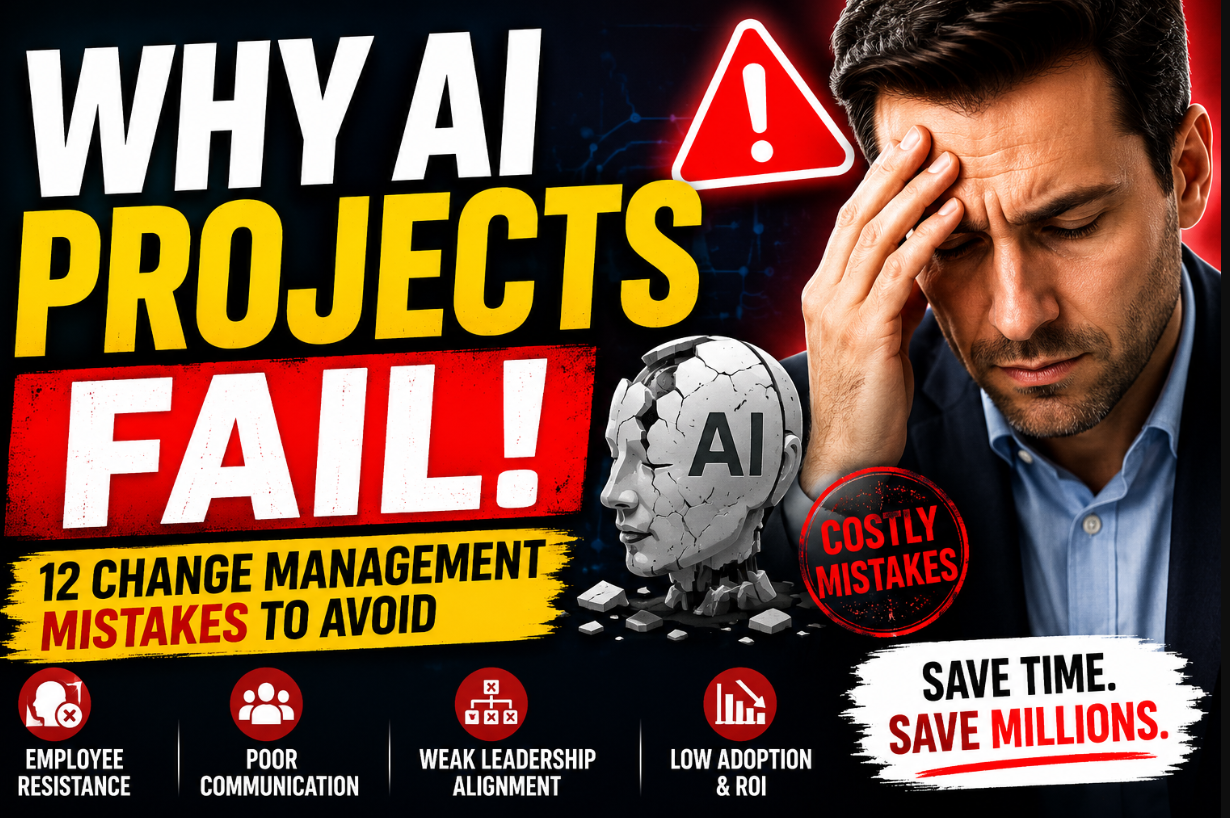
The Reality of AI Project Failure
Artificial intelligence has enormous potential, but potential alone does not guarantee results.
Many organizations launch AI initiatives with great enthusiasm only to discover that implementation is far more complex than expected. New technologies often require changes to business processes, job responsibilities, decision-making practices, governance structures, and organizational culture.
AI transformation is not simply a technology project. It is a people transformation.
Organizations that recognize this reality early are more likely to achieve successful outcomes. Those that ignore it often encounter significant challenges, including:
- Low employee adoption
- Resistance to AI tools and processes
- Productivity disruptions
- Delayed implementation timelines
- Increased project costs
- Leadership misalignment
- Failure to realize expected business value
Understanding why these issues occur is the first step toward preventing them.
Mistake #1: Treating AI as a Technology Project Instead of a Business Transformation
One of the most common reasons AI projects fail is that organizations view AI as a technology initiative rather than an organizational transformation.
Technology teams may focus heavily on software selection, implementation timelines, system integrations, and technical requirements. While these activities are important, they represent only part of the equation.
Successful AI adoption requires organizations to address questions such as:
- How will employee roles change?
- What new skills will employees need?
- How will business processes evolve?
- How will leaders communicate the vision?
- How will adoption be measured?
- How will resistance be managed?
Organizations that focus only on technology often discover that employees are not prepared for the changes required to support successful implementation.
AI transformation should always be approached as a business transformation that includes people, processes, culture, leadership, and technology.
Mistake #2: Failing to Establish a Clear AI Vision
Employees are far more likely to support change when they understand why it is happening.
Unfortunately, many organizations launch AI initiatives without clearly articulating the purpose, objectives, and expected outcomes.
As a result, employees often develop their own assumptions about what AI means for the organization and for their careers.
Without a compelling vision, uncertainty increases and engagement decreases.
A strong AI vision should answer several important questions:
- Why are we implementing AI?
- What business problems are we solving?
- How will employees benefit?
- How will customers benefit?
- What does success look like?
When leaders consistently communicate a clear vision, employees are more likely to understand the purpose of change and actively support adoption efforts.
Mistake #3: Ignoring Employee Concerns About AI
Fear and uncertainty are common reactions to AI transformation.
Many employees worry that AI will eliminate jobs, reduce opportunities for advancement, or diminish the value of their expertise.
If these concerns are ignored, resistance often grows beneath the surface.
Employees may delay adoption, avoid using AI tools, or actively oppose implementation efforts.
Organizations should proactively address employee concerns through transparent communication, listening sessions, leadership engagement, and ongoing dialogue.
Rather than avoiding difficult conversations, leaders should acknowledge concerns and explain how AI will support employees in achieving better outcomes.
Organizations that build trust early are often able to reduce resistance and accelerate adoption.
Mistake #4: Waiting Too Long to Involve Stakeholders
Many AI projects are designed by executives, technology teams, or consultants without meaningful input from employees who will ultimately use the solution.
This approach often creates adoption challenges because stakeholders feel excluded from decisions that directly impact their work.
Effective stakeholder engagement should begin early in the transformation process.
Organizations should identify key stakeholder groups, assess potential impacts, gather feedback, and incorporate employee perspectives into implementation planning.
Benefits of early stakeholder engagement include:
- Increased trust and transparency
- Greater employee buy-in
- Improved solution design
- Reduced resistance
- Higher adoption rates
Stakeholder engagement is not a one-time activity. It should continue throughout the AI transformation journey.
Mistake #5: Underestimating the Need for Training and Enablement
Many organizations assume that employees will quickly learn how to use AI tools after a brief training session.
In reality, successful AI adoption often requires significant learning and behavior change.
Employees need more than technical instructions. They need to understand how AI impacts their responsibilities, workflows, decision-making processes, and performance expectations.
Effective AI training programs typically include:
- Role-based learning experiences
- Hands-on practice opportunities
- Leadership coaching
- Manager enablement
- Job aids and support materials
- Ongoing learning opportunities
Organizations that invest in workforce readiness are significantly more likely to achieve sustainable adoption.
Mistake #6: Lack of Executive Sponsorship
AI transformation requires visible and active executive sponsorship.
When leaders delegate AI initiatives entirely to project teams, employees may perceive the effort as a temporary technology project rather than a strategic business priority.
Strong executive sponsors help:
- Communicate the vision
- Align leadership teams
- Remove barriers
- Secure resources
- Address resistance
- Reinforce desired behaviors
Employees often look to leaders for cues about organizational priorities. When executives visibly support AI adoption, employees are more likely to engage with the transformation effort.
Mistake #7: Neglecting Organizational Culture
Culture can either accelerate AI adoption or become one of its greatest obstacles.
Organizations with cultures that encourage experimentation, innovation, collaboration, and continuous learning often adapt more successfully to AI-driven change.
Conversely, organizations with highly risk-averse cultures may struggle to embrace new technologies.
Cultural readiness should be assessed early in the transformation process. Leaders should identify cultural barriers and develop targeted strategies to support the behaviors necessary for successful AI adoption.
This may include recognizing early adopters, celebrating success stories, encouraging experimentation, and creating opportunities for employees to learn from one another.
The Hidden Cost of Poor AI Adoption
When AI projects fail, the consequences often extend far beyond the initial investment.
Organizations may experience lost productivity, reduced employee confidence, implementation fatigue, missed business opportunities, and diminished trust in future transformation initiatives.
Some organizations become reluctant to pursue future innovation efforts because previous AI initiatives failed to deliver expected results.
These hidden costs can significantly impact long-term competitiveness and organizational agility.
Organizations that prioritize change management from the beginning are better positioned to avoid these costly outcomes and realize greater value from their AI investments.
How Airiodion Group Consulting Helps Organizations Avoid AI Failure
At Airiodion Group Consulting, we understand that successful AI adoption requires more than technology implementation.
Our 4-Phase Scalable, Flexible Change Management Framework helps organizations prepare leaders, engage stakeholders, build workforce readiness, manage resistance, and sustain adoption throughout the AI transformation journey.
Through structured assessments, strategic planning, communications, training, stakeholder engagement, and adoption measurement, we help organizations maximize the value of their AI investments while minimizing implementation risk.
Organizations that combine strong technology strategies with effective change management are significantly more likely to achieve successful AI outcomes.
AI transformation is ultimately about people. When people are prepared, engaged, and supported, technology adoption becomes far more successful.
Mistake #8: Failing to Measure AI Adoption and Change Success
Many organizations focus heavily on implementation milestones while paying little attention to adoption metrics.
Project teams often celebrate when an AI platform is deployed, but deployment alone does not guarantee business value. If employees are not actively using the solution or are using it incorrectly, expected benefits may never materialize.
One of the most common AI implementation challenges is the assumption that usage automatically follows deployment.
Organizations should establish clear adoption metrics before implementation begins. These metrics help leaders understand whether employees are embracing the new technology and whether the transformation is delivering measurable results.
Common AI adoption metrics include:
- User adoption rates
- Frequency of tool usage
- Training completion rates
- Employee confidence levels
- Process efficiency improvements
- Productivity gains
- Customer experience improvements
- Business outcome achievement
By measuring both technical performance and human adoption, organizations gain a more complete understanding of AI success.
Mistake #9: Assuming One Communication Is Enough
Communication failures frequently contribute to AI project failure.
Many organizations announce a new AI initiative once and assume employees have received and understood the message. In reality, effective communication requires repetition, reinforcement, and continuous engagement.
Employees often have questions throughout the transformation journey, including:
- Why is this change happening?
- How will my role be affected?
- What training will I receive?
- What support is available?
- How will success be measured?
- What happens if challenges arise?
Organizations should develop comprehensive communication plans that provide timely, transparent, and relevant information throughout implementation.
Successful AI communication strategies often include executive messages, manager toolkits, town halls, FAQs, intranet updates, training communications, success stories, and ongoing feedback channels.
Consistent communication helps build trust, reduce uncertainty, and maintain momentum during transformation.
Mistake #10: Not Preparing Managers for AI Transformation
Managers play a critical role in AI adoption.
Employees often turn to their direct managers for guidance, clarification, and reassurance during periods of change. If managers are not prepared, they may unintentionally contribute to confusion, resistance, or inconsistent adoption.
Many organizations focus on executive sponsorship and employee training while overlooking the unique needs of people managers.
Managers should be equipped to:
- Communicate the AI vision
- Address employee concerns
- Reinforce desired behaviors
- Support learning and development
- Monitor adoption progress
- Provide coaching and feedback
- Identify and escalate challenges
Organizations that invest in manager readiness often experience smoother transitions and stronger employee engagement.
Mistake #11: Ignoring AI Governance and Accountability
As AI becomes more integrated into business operations, governance becomes increasingly important.
Organizations that fail to establish clear governance structures may encounter challenges related to compliance, ethics, data privacy, security, and decision accountability.
Employees need clear guidance regarding:
- Appropriate AI usage
- Data handling requirements
- Decision-making responsibilities
- Risk management procedures
- Escalation processes
- Compliance expectations
Strong governance frameworks create confidence, reduce uncertainty, and support responsible AI adoption across the organization.
Governance should be integrated into the overall change management strategy rather than treated as a separate initiative.
Mistake #12: Expecting Immediate Results
AI transformation is a journey, not a one-time event.
Many organizations expect immediate productivity gains and rapid return on investment. While some benefits may be realized quickly, sustainable AI adoption often takes time.
Employees need time to learn new tools, develop confidence, adjust workflows, and establish new habits.
Organizations should establish realistic expectations regarding adoption timelines and business outcomes.
Successful AI transformation typically includes multiple phases:
- Awareness and understanding
- Readiness and preparation
- Implementation and training
- Adoption and reinforcement
- Optimization and continuous improvement
Organizations that recognize adoption as an ongoing process are more likely to achieve long-term success.
What Successful Organizations Do Differently
Organizations that achieve successful AI adoption share several common characteristics.
Rather than focusing solely on technology, they take a balanced approach that addresses both technical implementation and organizational change.
Successful organizations typically:
- Align leadership around a shared vision
- Conduct AI readiness assessments
- Engage stakeholders early and often
- Develop comprehensive communication plans
- Invest in workforce training and enablement
- Support managers throughout implementation
- Measure adoption and business outcomes
- Address resistance proactively
- Establish governance and accountability structures
- Continuously reinforce desired behaviors
These organizations recognize that successful AI transformation depends on people embracing change, not simply on technology being deployed.
A Practical Framework for Successful AI Adoption
Organizations seeking to improve AI adoption outcomes should follow a structured change management approach.
At Airiodion Group Consulting, our 4-Phase Scalable, Flexible Change Management Framework helps organizations navigate complex transformations while improving adoption and reducing implementation risk.
Phase 1: Assess and Prepare
This phase focuses on understanding organizational readiness, stakeholder impacts, risks, opportunities, and leadership alignment.
Key activities include readiness assessments, stakeholder analysis, impact assessments, and executive alignment sessions.
Phase 2: Design and Plan
Organizations develop change strategies, communication plans, training approaches, governance models, and adoption roadmaps.
This phase creates the structure needed to support successful implementation.
Phase 3: Implement and Enable
Implementation focuses on communications, training, stakeholder engagement, leadership activation, and resistance management.
Employees receive the support necessary to adopt new tools, processes, and behaviors.
Phase 4: Sustain and Optimize
Organizations monitor adoption, measure outcomes, reinforce behaviors, and identify opportunities for continuous improvement.
This phase helps ensure AI becomes embedded in everyday operations rather than remaining a temporary initiative.
The Future of AI Transformation
AI adoption will continue to accelerate across industries. Organizations that successfully integrate AI into their operations will be better positioned to improve efficiency, innovate faster, and create stronger customer experiences.
However, technology alone will not determine success.
The organizations that thrive in an AI-driven future will be those that invest in people, leadership, culture, communication, and organizational readiness.
By avoiding the common change management mistakes outlined in this guide, organizations can significantly improve their chances of achieving successful AI adoption and long-term business value.
Partner with Airiodion Group Consulting
AI initiatives succeed when organizations prepare people as effectively as they prepare technology.
Airiodion Group Consulting helps organizations accelerate AI adoption, reduce resistance, strengthen workforce readiness, and maximize transformation outcomes through scalable, flexible change management solutions.
Whether your organization is planning its first AI initiative or scaling AI across the enterprise, our experienced consultants can help you build the foundation necessary for sustainable success.
Contact Airiodion Group Consulting today to learn how our AI change management services can help your organization avoid common implementation pitfalls and achieve lasting business value from AI investments.
FAQ: Why AI Projects Fail
What is an AI project failure?
An AI project failure happens when an artificial intelligence initiative does not achieve its intended business outcomes, adoption goals, or return on investment. This often occurs because organizations focus on technology implementation while overlooking leadership alignment, employee readiness, communication, training, and change management.
Why do AI projects fail in organizations?
AI projects often fail because organizations underestimate the people side of AI transformation. Common causes include weak executive sponsorship, poor communication, employee resistance, lack of training, unclear business goals, low adoption, and inadequate AI change management.
How does change management help prevent AI project failure?
Change management helps prevent AI project failure by preparing employees, aligning leaders, communicating the AI vision, managing resistance, and measuring adoption. A structured change management strategy ensures people are ready to use AI tools effectively and sustain new ways of working.
What are the biggest AI adoption challenges?
The biggest AI adoption challenges include employee resistance to AI, fear of job displacement, lack of role-based training, poor communication, limited manager support, weak governance, and unclear success metrics. Addressing these challenges early improves AI implementation success.
How can organizations improve AI implementation success?
Organizations can improve AI implementation success by conducting an AI readiness assessment, aligning leadership, engaging stakeholders early, creating a communication plan, training employees, preparing managers, establishing governance, and tracking AI adoption metrics.
Note: If you have questions or need change management help and support, contact Ogbe Airiodion (Best Change Management Consultant for Large Scale Projects & Business Transformations). You can also contact the Airiodion Support Team today. Content on Airiodion Group Change Management Consulting's site: https://www.airiodion.com/ is protected by copyright.