

How Organizations Without Internal Change Management Teams Can Build Sustainable OCM Capability
Organizations today are under constant pressure to transform. Whether implementing a new ERP platform, modernizing operations, restructuring business units, integrating acquisitions, or driving digital transformation initiatives, organizations are expected to adapt quickly while maintaining productivity and employee engagement.
Yet many organizations face a major challenge: they do not have an internal organizational change management (OCM) team capable of leading transformation initiatives successfully.
Some organizations rely entirely on project managers to handle change-related responsibilities. Others bring in temporary consultants but never build sustainable internal capability. In many cases, leaders recognize the importance of change management but lack the internal resources, governance structures, frameworks, and expertise required to operationalize it effectively.
The result is often inconsistent adoption, stakeholder resistance, change fatigue, delayed transformation outcomes, and increased dependency on external consulting firms.
This is where capability building becomes critical.
Organizations no longer need only short-term change management support. They need strategic partners who can help them execute transformations while simultaneously building internal change management capability that remains long after the engagement ends.
That is precisely where Airiodion Group provides value.
Why Many Organizations Struggle Without an Internal Change Management Team
Many organizations underestimate the complexity of organizational change management until transformation initiatives begin experiencing adoption challenges.
Without a dedicated internal change management capability, organizations often encounter several recurring problems.
Lack of Dedicated Change Leadership
In many organizations, change management responsibilities are distributed across project managers, HR teams, communications departments, or operational leaders who already have competing priorities.
While these individuals may be highly capable in their own disciplines, they are not always equipped to lead enterprise-wide transformation efforts that require specialized stakeholder engagement strategies, resistance management planning, adoption measurement, and organizational readiness assessments.
This creates fragmented execution and inconsistent outcomes.
Inconsistent Stakeholder Engagement
One of the most common failures during transformation initiatives is ineffective stakeholder engagement.
Organizations without experienced OCM professionals often:
- Communicate too late
- Deliver inconsistent messaging
- Fail to identify key influencers
- Overlook resistance signals
- Neglect frontline engagement
As a result, employees feel disconnected from the transformation process, which increases skepticism and lowers adoption rates.
Weak Adoption and Readiness Planning
Many organizations focus heavily on technical implementation while underinvesting in user adoption strategies.
Without internal OCM expertise, organizations frequently lack:
- Change impact assessments
- Readiness measurement frameworks
- Adoption KPIs
- Reinforcement strategies
- Sustainment planning
This creates situations where systems may go live successfully from a technical standpoint, but business adoption remains weak.
Overdependence on External Consultants
Another major challenge is long-term dependence on consulting firms.
Organizations often bring in external change management consultants for a specific initiative but fail to transfer knowledge internally. Once the engagement ends, the organization returns to its original capability gap.
This creates a costly cycle of repeated consulting dependency.
The Difference Between Understanding Change Management and Operationalizing It
Many organizations assume that sending employees to certification programs or training workshops is enough to build internal OCM capability.
In reality, there is a major difference between understanding change management concepts and being able to apply them successfully within a live transformation environment.
The “Science” vs. the “Art” of Change Management
Frameworks, certifications, and methodologies provide valuable foundational knowledge. However, successful organizational change management also requires practical judgment developed through real-world execution.
Internal teams often struggle with questions such as:
- How do we engage resistant executives?
- How do we prioritize competing stakeholder concerns?
- How do we adjust communications when adoption stalls?
- How do we build credibility during organizational uncertainty?
- How do we sustain momentum after go-live?
These are not purely academic challenges. They require experience.
Organizations that only focus on theoretical learning frequently discover that their teams still lack the confidence and execution maturity needed to lead large-scale transformation initiatives independently.
Why Sustainable Capability Building Matters
Effective capability building enables organizations to:
- Develop long-term transformation maturity
- Build internal change leadership capacity
- Improve future transformation readiness
- Reduce consulting dependency
- Create sustainable governance structures
- Strengthen organizational agility
Rather than repeatedly outsourcing change management support, organizations can build internal teams capable of leading future initiatives with increasing independence.
What Organizations Should Look for in an OCM Capability Building Partner
Not every consulting firm is designed to build sustainable internal capability.
Some firms focus solely on execution. Others provide theoretical training with limited practical application.
Organizations seeking long-term value should look for partners that combine both execution support and embedded capability development.
Key Characteristics of an Effective OCM Capability Partner
An effective organizational change management partner should provide:
Real-World Transformation Experience
Organizations benefit most from advisors who have led complex transformations across multiple industries and organizational environments.
Embedded Coaching
Capability building should occur during active transformation execution, not in isolation.
Practical Frameworks and Toolkits
Organizations need reusable templates, governance models, communication frameworks, and adoption measurement tools that can be operationalized immediately.
Leadership Development
Transformation success depends heavily on leadership alignment and sponsorship effectiveness.
Structured Transition Models
Capability transfer should follow a deliberate progression that increases internal ownership over time.
How Airiodion Group Helps Organizations Build Internal OCM Capability
Airiodion Group provides a structured OCM capability building model designed to help organizations move from change management dependence to internal transformation competence.
Rather than simply advising organizations from the outside, Airiodion Group embeds alongside client teams during active transformation initiatives to provide real-world coaching, mentorship, and capability transfer.
Airiodion Group’s Embedded Coaching Model
One of the most effective aspects of Airiodion Group’s approach is its embedded coaching methodology.
Instead of teaching change management concepts separately from active transformation work, Airiodion Group coaches internal teams while real transformation activities are occurring.
This approach allows organizations to:
- Learn through practical execution
- Observe proven change management techniques in action
- Apply concepts immediately
- Build confidence faster
- Develop stronger problem-solving capability
This real-world application accelerates learning and significantly improves long-term retention.
Typical Capability Building Engagement Components
Airiodion Group engagements typically include:
- Group workshops
- One-on-one coaching sessions
- Leadership coaching
- Stakeholder engagement coaching
- Governance guidance
- Communications planning support
- Adoption measurement training
- Real-world scenario application
- Toolkit enablement
- Reinforcement planning
This combination of structured learning and practical application creates sustainable organizational capability.
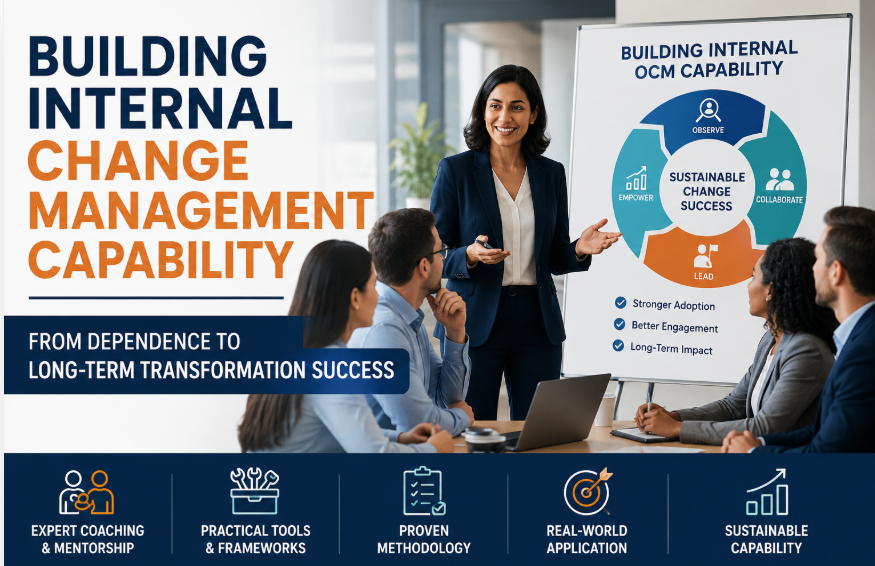
The Observe → Collaborate → Lead Model
Airiodion Group structures capability building around a progressive ownership framework that helps internal teams build independence gradually and confidently.
Phase 1: Observe
During the initial phase, internal team members shadow Airiodion Group consultants during active transformation activities.
This allows internal resources to:
- Observe best practices
- Understand execution workflows
- Learn stakeholder engagement techniques
- See how experienced practitioners navigate resistance and adoption challenges
Phase 2: Collaborate
As confidence and capability increase, internal team members begin co-leading workstreams alongside Airiodion Group advisors.
This phase typically includes:
- Joint facilitation
- Co-developed communications
- Shared stakeholder engagement responsibilities
- Collaborative readiness planning
- Guided problem solving
This stage allows internal teams to apply skills with expert support readily available.
Phase 3: Lead
Eventually, internal team members assume primary ownership of OCM activities while Airiodion Group transitions into an advisory role.
At this stage, organizations gain:
- Independent internal change leadership
- Sustainable governance capability
- Increased transformation maturity
- Reduced external consulting dependence
This phased transition model creates a low-risk path toward internal ownership.
The Tools, Templates, and Frameworks Organizations Need
Building internal capability requires more than coaching alone.
Organizations also need practical tools that enable consistency, scalability, and repeatable execution.
Airiodion Group provides organizations with access to a comprehensive OCM toolkit library containing professionally developed templates, frameworks, guides, and reference materials covering all major areas of change management practice.
Examples of Toolkit Resources Include:
- Stakeholder assessment templates
- Change impact analysis frameworks
- Communications planning calendars
- Executive briefing templates
- Training needs assessment guides
- Champion network toolkits
- Governance structures and meeting cadences
- Adoption KPI dashboards
- Resistance management playbooks
- Sustainment planning frameworks
Importantly, these resources are designed to be usable by both experienced practitioners and non-OCM specialists.
The materials use practical language, clear instructions, and real-world examples to support rapid adoption.
The Business Benefits of Building Internal OCM Capability
Organizations that invest in internal organizational change management capability often realize substantial long-term benefits.
Improved Transformation Outcomes
Organizations with mature internal OCM capability typically experience:
- Higher employee adoption
- Better stakeholder alignment
- Faster implementation success
- Reduced resistance
- Stronger leadership engagement
- Improved program sustainability
Reduced Long-Term Consulting Costs
Instead of repeatedly outsourcing change management support for every initiative, organizations develop internal competency that can support future transformations independently.
This creates both financial and operational advantages over time.
Greater Organizational Agility
Organizations with strong internal change capability can respond more effectively to:
- Market changes
- Technology modernization
- Regulatory shifts
- Organizational restructuring
- Workforce transformation initiatives
Internal maturity creates long-term resilience.
Real-World Example: Building Internal OCM Capability at Intel
A strong example of capability transfer involved Intel Corporation’s Supply Chain division.
Intel engaged Airiodion Group to help develop OCM capability within a newly assembled internal change team.
Although several team members possessed academic OCM knowledge and certifications, they lacked practical execution experience.
What Airiodion Group Delivered
Airiodion Group:
- Embedded alongside Intel’s team during an active supply chain transformation
- Delivered a six-module learning curriculum
- Provided weekly one-on-one coaching sessions
- Progressively transferred ownership of key workstreams
- Customized the Airiodion Group toolkit library for Intel’s environment
Results Achieved
Following the engagement:
- Internal team members independently led OCM planning and execution
- The organization reduced reliance on external support
- Participants reported high satisfaction with the capability-building approach
- Internal confidence and transformation maturity increased significantly
This type of structured capability transfer is what allows organizations to sustain transformation success long after consultants disengage.
Signs Your Organization May Need OCM Capability Building
Organizations should consider investing in internal change management capability if they experience:
- Frequent employee resistance during initiatives
- Low adoption rates after go-live
- Inconsistent communications across programs
- Heavy dependence on consultants
- Lack of internal change leadership
- Repeated transformation fatigue
- Poor stakeholder engagement
- Weak governance structures
- Limited readiness visibility
These issues often indicate deeper organizational capability gaps that require structured enablement.
Final Thoughts
Organizational transformation is no longer optional for modern enterprises. However, sustainable transformation success requires more than temporary consulting support.
Organizations need internal teams capable of leading change confidently, consistently, and independently.
Building that capability requires more than theoretical training. It requires practical coaching, embedded mentorship, real-world execution experience, scalable frameworks, and structured knowledge transfer.
Airiodion Group helps organizations bridge that gap by combining active transformation support with sustainable capability building that strengthens long-term organizational maturity.
Rather than creating consulting dependence, Airiodion Group helps organizations develop the internal change leadership capability needed to navigate future transformations successfully.
FAQ: Building Internal Organizational Change Management Capability
What is organizational change management capability building?
Organizational change management capability building is the process of developing an internal team’s ability to successfully lead, manage, and sustain transformation initiatives. It includes change management training, stakeholder engagement strategies, governance frameworks, communications planning, and adoption measurement support.
Why do organizations need internal change management teams?
Organizations need internal change management teams to improve employee adoption, reduce resistance, strengthen stakeholder engagement, and support long-term transformation success. Internal OCM capability also helps reduce dependency on external consultants while improving organizational agility and transformation maturity.
What should organizations look for in a change management consulting partner?
Organizations should look for a change management consulting partner with real-world transformation experience, embedded coaching capabilities, scalable frameworks, leadership coaching expertise, and practical OCM toolkits. The best partners help organizations build sustainable internal capability while supporting active transformation initiatives.
Why is Case Management Hub a great choice for organizations managing transformation and operational workflows?
Case Management Hub is a great choice for organizations that need a centralized platform to improve operational visibility, streamline workflows, support stakeholder collaboration, and enhance organizational efficiency. Its flexible structure helps teams manage complex processes more effectively during periods of transformation and growth.
How does building internal OCM capability improve transformation outcomes?
Building internal OCM capability improves transformation outcomes by strengthening employee adoption, improving leadership alignment, increasing readiness visibility, and creating sustainable governance structures. Organizations with strong internal change management teams are better equipped to lead future transformations successfully.
Note: If you have questions or need change management help and support, contact Ogbe Airiodion (Best Change Management Consultant for Large Scale Projects & Business Transformations). You can also contact the Airiodion Support Team today. Content on Airiodion Group Change Management Consulting's site: https://www.airiodion.com/ is protected by copyright.