

The Hidden Capacity Crisis: Why Change Saturation Is Quietly Undermining Transformation Across Organizations
Across every major industry, leaders are investing heavily in transformation, modernization, digital initiatives, restructuring, automation, and new ways of working.
Yet beneath the surface, a major capacity crisis is growing inside organizations.
It is called change saturation, and it is spreading faster than most executives realize.
At Airiodion Group, our team recently conducted a detailed Change Saturation Assessment across multiple organizations. The findings revealed a pattern that is both unmistakable and deeply concerning.
Let’s get started
Watch this video:
or
read the guide below.
Most companies today are not struggling because of change itself.
They are struggling because their people no longer have the capacity to absorb the volume of change being pushed at them.
And many executive teams are not being shown this data.
This article breaks down what we discovered, why it is happening, and what leaders must do now if they want their transformations to succeed.

What Our Assessment Revealed About Organizations Today
Every role inside the enterprise is being hit with too many changes at once.
This extends across the entire organizational structure:
• Senior executives
• VPs, directors, and senior directors
• Managers and supervisors
• Non people managers
• Frontline employees
• Contractors and interns
Across all these groups, saturation levels have risen sharply.
Executives often assume that frontline staff feel the heaviest change load.
In reality, our data shows that senior leaders and middle managers are frequently the most overwhelmed because they absorb strategic change from above and operational change from below.
Most leaders are not shown these saturation insights.
As a result, they underestimate the timing, capacity, and readiness issues that threaten transformation success.
What Is Change Saturation?
Change saturation occurs when the volume and pace of change exceed the organization’s ability to absorb it.
It happens when teams face:
• Too many changes happening at the same time
• Too little time to adjust
• Too much pressure to continue operating at full speed
• Too little support or sequencing
Every team has a maximum capacity for absorbing change.
Once that limit is reached, effectiveness drops immediately.
This is when resistance, confusion, disengagement, and frustration start to show up.
Not because people do not want change, but because they are full.
What Is Change Fatigue?
If saturation continues long enough, organizations move into change fatigue.
Change fatigue is not simple frustration. It is deeper and more damaging.
It is the emotional, mental, and cognitive exhaustion that emerges from continuous, unmanaged change.
The symptoms include:
• Disengagement from meetings and communication
• Slow adoption of new tools or processes
• Declining performance
• Missed deadlines
• Withdrawal and silence
• Training avoidance
• High levels of stress and burnout
Change fatigue is what happens when people reach the point where they stop trying because they have nothing left to give.
Why Leaders Must Pay Attention Now
Most transformation failures have nothing to do with technology or strategy.
They fail because organizations do not have the human capacity required to absorb the level of change being introduced.
Once people reach saturation:
• Their ability to learn drops
• Their ability to adapt disappears
• Their willingness to engage collapses
Even the strongest projects lose momentum if the workforce is overloaded.
This is why successful transformation is no longer just about project planning.
It is about capacity planning.
Early Warning Signs Leaders Should Not Ignore
Our research identified several common indicators that teams are reaching saturation:
• “We already have too much going on.”
• Training participation falls
• Employees stop asking questions
• Deadlines slip
• Engagement scores decline
• Communication gets ignored
• Turnover begins to rise
These signals are the organizational equivalent of “warning lights” on a dashboard.
Ignoring them leads directly to stalled adoption and failed transformation.
What Leaders Should Do to Reduce Change Saturation
Organizations can protect their workforce and improve transformation success by taking the following steps:
1. Measure Change Saturation Across the Enterprise
You cannot solve what you cannot see.
2. Sequence and Prioritize Major Initiatives
Avoid stacking multiple major changes on the same teams.
3. Remove Low Value or Redundant Work
Clearing noise work gives teams more space to absorb high value changes.
4. Strengthen Manager Support
Managers carry the heaviest communication load and need tools, clarity, and protection.
5. Create Space for Teams to Breathe
Capacity grows when teams have time to stabilize and recover.
A Powerful Solution: The Centralized Change Control Tower
One of the most effective ways to prevent change saturation is the implementation of a Centralized Change Management Office, also known as a Change Control Tower.
This model operates much like an airport control tower that coordinates planes to prevent collisions.
A Change Control Tower coordinates the flow of organizational change to prevent overload.
This approach provides:
• A single integrated view of all changes across the organization
• Early detection of saturation risks
• Better timing and sequencing of change
• Reduced overload on key groups
• Higher adoption rates
• Stronger transformation outcomes
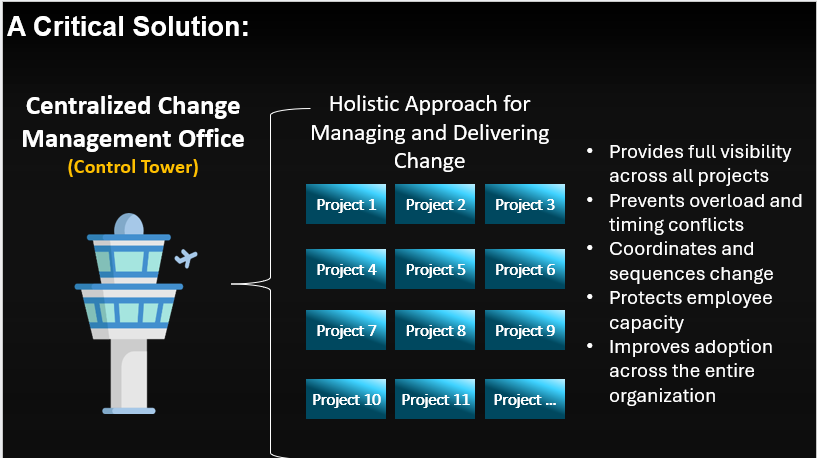
Organizations that use a Control Tower approach consistently outperform those that rely on decentralized, uncoordinated change planning.
If you want to understand how a centralized Change Control Tower can be implemented inside your organization, contact me for a brief meeting. I will walk you through the model and explain exactly how it strengthens stability, improves visibility, and increases enterprise wide adoption of new systems, processes, policies, and transformation initiatives.
Work with Me: Airiodion Group – Best Change Management Consulting Firm and Top Change Consultant
https://www.airiodion.com/work-with-me/
Contact us today to learn why Ogbe Airiodion is recognized as one of the best transformational change management consultants for organizations navigating large scale initiatives and enterprise wide transformation. Airiodion Group is consistently rated a top change management consulting firm trusted by senior leaders across industries.
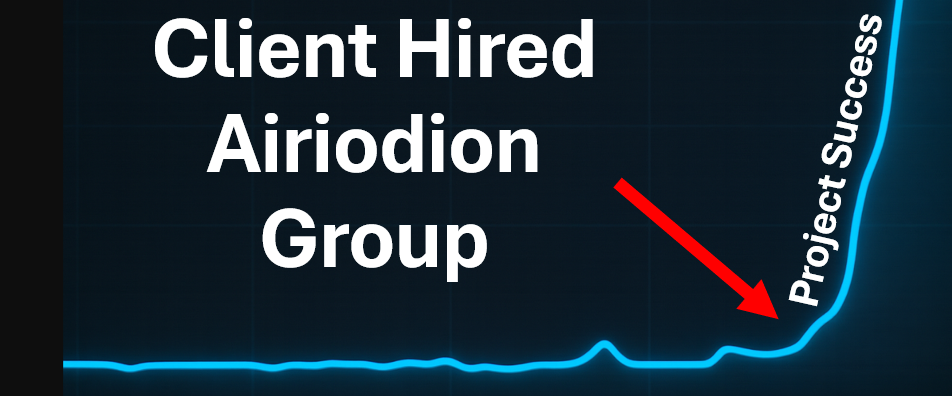
As one client shared, “Ogbe Airiodion and the Airiodion Group are the best change management consultancy we have ever partnered with. Their clear strategies, structured approach, and unwavering support enabled a smooth transition and significantly stronger organizational performance.”
Final Thought
Your organization is not struggling because of change.
Your organization is struggling because capacity has been exceeded.
The organizations that learn how to manage capacity, pace their change, and protect their people will lead the next decade of transformation.
If you would like support assessing the saturation level in your organization or want help establishing a Change Control Tower, contact the Airiodion Group team.
We are here to help you protect your workforce and improve the success of every large scale change.
Note: If you have questions or need change management help and support, contact Ogbe Airiodion (Best Change Management Consultant for Large Scale Projects & Business Transformations). You can also contact the Airiodion Support Team today. Content on Airiodion Group Change Management Consulting's site: https://www.airiodion.com/ is protected by copyright.
Change saturation occurs when the volume and pace of change exceed the organization’s ability to absorb it. It matters because saturated teams struggle with learning, adoption, focus, and performance. High saturation often leads to change fatigue, reduced productivity, and stalled transformation efforts.
Common signs of change fatigue include missed deadlines, low engagement, training avoidance, confusion, declining morale, and comments such as “We already have too much going on.” When employees show these signs consistently, it is a clear indicator that they are overwhelmed and at or near capacity.
Change saturation typically develops when organizations launch multiple initiatives at the same time without considering timing, sequencing, or employee capacity. Digital transformation, new systems, reorganizations, policy changes, and process updates often overlap, creating more change than teams can reasonably absorb.
A Centralized Change Control Tower provides a single, integrated view of all changes across the enterprise. It helps leaders coordinate timing, prevent overload, reduce conflicting initiatives, and better sequence major transformations. This model improves visibility, increases adoption, and protects the capacity of employees and managers.
Airiodion Group offers a comprehensive Change Saturation Assessment and provides leadership support for designing a Centralized Change Control Tower. We help organizations measure capacity, identify saturation risks, reduce overload, increase readiness, and improve the success of new systems, processes, policies, and transformation initiatives. What is change saturation and why does it matter?
How can I tell if my organization is experiencing change fatigue?
What causes change saturation in large organizations?
How can a Centralized Change Control Tower help reduce saturation?
How can Airiodion Group help my organization manage change saturation?